
Beyond the Hype: Building a Programmatic SEO Engine with LLMs (and Forecasting the ROI)
Programmatic SEO (pSEO) is rapidly shifting from manual database plugging to fully automated, AI-driven architectures.

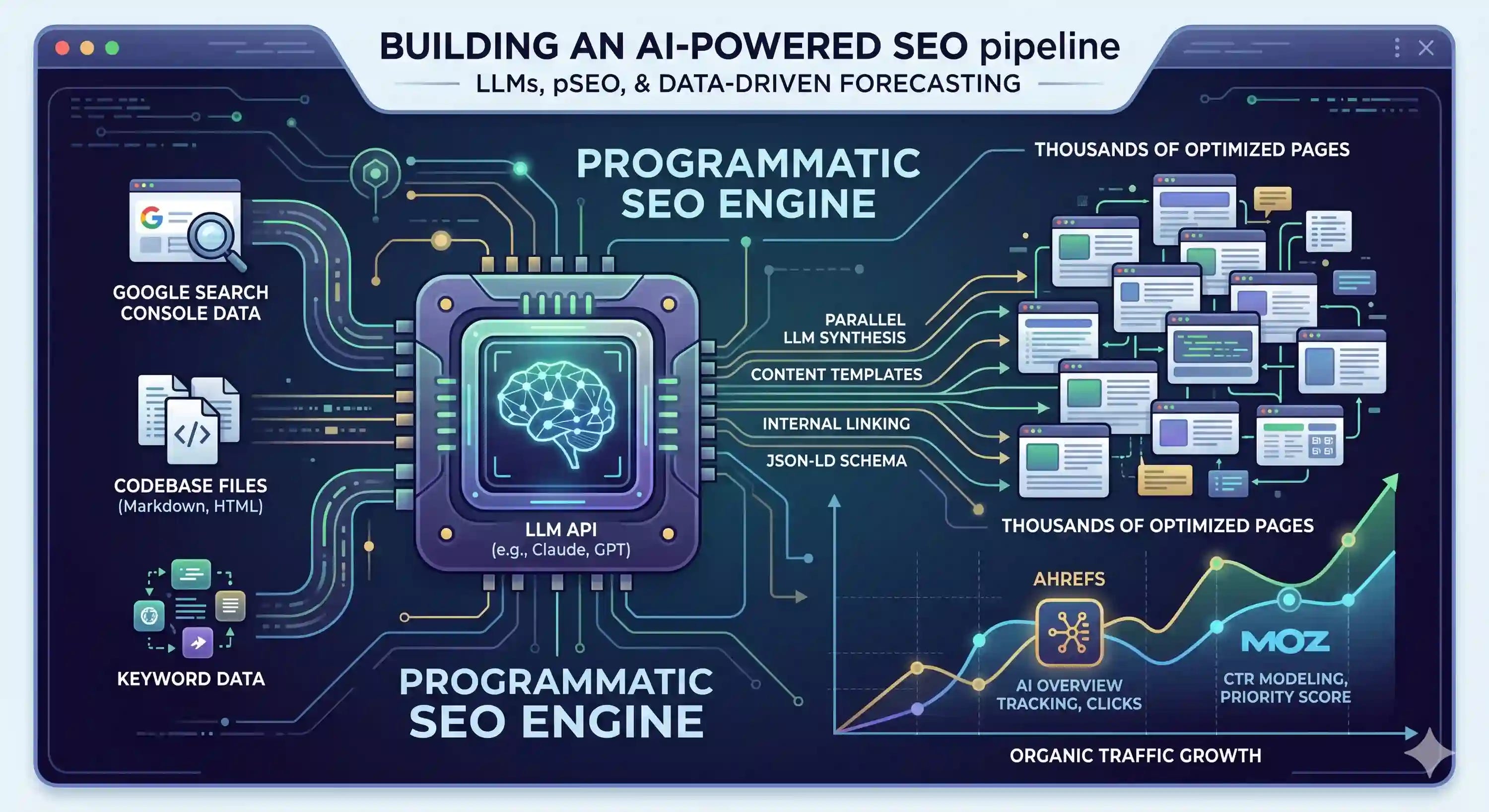
For developers and SEO strategists looking to scale organic search traffic without proportionally scaling their content teams, pSEO is the answer. It combines structured datasets with intelligent templates to generate thousands of high-ranking, long-tail pages. But deploying this successfully requires more than just calling an API; it demands a systemic approach to data ingestion and advanced rank forecasting.
The Case Study: Building a pSEO Pipeline with LLM APIs
To understand the practical application of LLMs in programmatic SEO, we can look at the architecture of serpIQ, an open-source SEO audit CLI developed by Manoj Ahi. Unlike generic SEO workflows that blindly generate text, a well-engineered pipeline grounds the LLM in deterministic data before any synthesis occurs.
Here is the code-level logic breakdown of a successful LLM API pipeline for programmatic SEO:
Context Extraction: The pipeline first reads local project files (
README.md,package.json, codebase directory structures, and landing page HTML). This allows the LLM to infer the core product offering and identify topical gaps natively, rather than relying on abstract prompts.Deterministic Data Syncing: The system pulls raw, 90-day performance data directly from Google Search Console (GSC). This securely identifies “striking-distance” keywords (queries ranking in positions 5-30) and high-impression, low-CTR targets. Furthermore, it clusters URLs by parent path to surface existing pSEO patterns that are already working.
Keyword Expansion: Using real-world autocomplete data scraped directly from Google, the system seeds an LLM API (such as Anthropic’s Claude Sonnet 4.5 or OpenAI’s GPT-4o) with exact keyword structures, bypassing LLM hallucinations.
Parallel LLM Synthesis (The Engine): Instead of a single massive prompt that overwhelms small models, the architecture fires off focused, parallel LLM calls. One call generates strategic keyword clusters, while separate, simultaneous calls handle pSEO seed expansion. The LLM generates meta templates, required page sections with minimum word counts (to guard against Google’s thin-content penalties), internal-linking strategies, and an automated launch checklist.
Enforced Output Generation: Using JSON mode, the LLM’s response is forced into strict schema compliance, outputting Markdown files for content and copy-paste JSON-LD structured data. This makes the generated briefs and page specs instantly ready for automated CMS deployment.
Also read:
The Ultimate Guide to Local SEO Services: Drive Traffic, Leads, and Sales to Your Local Business
Measuring the Lift: Organic Traffic Forecasting with Ahrefs vs. Moz
Once your LLM-driven pSEO engine is deployed, forecasting organic traffic becomes the next critical hurdle. Traditional rank tracking is no longer sufficient due to the prevalence of zero-click searches and the injection of AI Overviews into the SERPs.
When forecasting the organic lift of a pSEO campaign, tool selection heavily influences the accuracy of your traffic predictions:
Ahrefs for AI-Impacted Forecasting: Ahrefs boasts a massive database of 10 billion keywords and achieves a 91% correlation with actual search volumes. Crucially for forecasting, Ahrefs’ unique “Clicks” methodology accounts for SERP features, and its Rank Tracker directly monitors positions within AI Overviews (positions 1, 2, and 3). Because AI summaries often replace traditional high-converting Rank 1 positions, tracking this pre/post-AI Overview impact is essential to accurately quantify your expected organic traffic from programmatic pages.
Moz for CTR Modeling: Moz operates on a smaller keyword dataset (500M+) but utilizes a proprietary Priority Score algorithm that synthesizes volume, keyword difficulty, and organic CTR modeling. While this reduces decision paralysis and adds reliable click prediction, its database limitations create coverage gaps in the long-tail spectrum. Because pSEO campaigns live and die in the long-tail, relying solely on Moz may leave gaps in your deep programmatic forecasting, requiring supplementary tools.
The Takeaway
Automating search growth isn’t about volume generation; it’s about data structure. By pairing intelligent LLM API pipelines that synthesize your codebase and live GSC metrics with robust forecasting ecosystems like Ahrefs, you can engineer an organic growth engine that is both scalable and completely predictable.
Sources Report: This article synthesizes technical insights from developer Manoj Ahi’s open-source serpIQ repository on GitHub, alongside metric and forecasting analysis published by CS Web Solutions.