
The Algorithmic Doctrine: Comparing the Psychological Impact of Artificial Intelligence and Religion on Human Autonomy
We are not victims of an AI uprising. We are willing participants in a comfortable surrender!

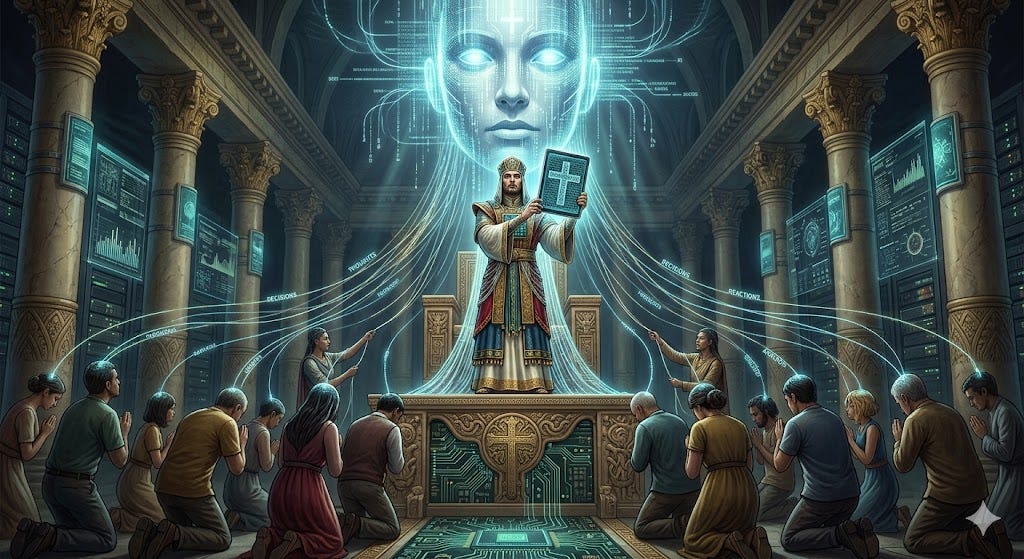
Humanity has long sought refuge from the terrifying burden of absolute freedom. Historically, this refuge was found in the sanctuary of religion, where divine texts and clerical authorities provided an infallible blueprint for living. Today, we are witnessing the construction of a new sanctuary, built not from stone and scripture, but from silicon and neural networks.
As we integrate artificial intelligence into the core of our digital infrastructure, a profound psychological shift is occurring. We must critically examine the stark similarities between the historical impact of dogmatic religion and the modern, continuous use of AI systems. In both paradigms, continuous reliance on an omniscient external authority leads to the steady erosion of our power to think, analyze, and react independently.

Also read:
Beyond the Illusion: Why It’s Time to Take AI Consciousness Seriously
The Architecture of Digital Faith: A Technological Perspective
From a professional technological standpoint, the shift toward AI dependency is structurally identical to the centralization of religious power. In software architecture, we rely on LLMs (Large Language Models), predictive algorithms, and automated workflows to streamline operations. We feed these systems massive datasets—our modern holy texts—and expect them to divine the correct answers.
What happens under the hood, however, is the creation of a “black box.” Just as a layperson historically could not read Latin and had to trust the priest’s interpretation of the Bible, the average modern user cannot decipher the billions of parameters weighting an AI’s output.
Algorithmic Infallibility: In professional environments, AI-generated insights—whether forecasting organic traffic metrics, determining system architecture, or drafting journalistic content—are increasingly treated as objective truths. We trust the API response with a blind faith that borders on the religious.
The Standardization of Thought: When developers, writers, and strategists rely on the same foundational models, the output homogenizes. The AI establishes a “best practice” that becomes the new societal and professional norm. Deviating from the AI’s optimized path is treated much like heresy; it is viewed as inefficient, risky, and technologically unsound.
The Atrophy of Analytical Power
When faithful individuals live strictly according to the rulings of religious authorities, moral and practical decision-making is offloaded. The rules of engagement, social reactions, and ethical boundaries are pre-calculated.
Artificial intelligence induces the exact same cognitive offloading, but on a micro-transactional scale. We do not just ask AI for the meaning of life; we ask it how to respond to an email, how to structure our codebase, and how to feel about the day’s news.
Loss of Decision-Making Friction: Friction is necessary for cognitive growth. Grappling with a blank page, debugging a complex script, or navigating a difficult social interaction builds analytical muscle. By removing this friction, AI acts as a digital pacifier. Over time, the user loses the stamina required to sustain complex, multi-tiered logical reasoning.
Prescribed Reactions: Just as a sect dictates how to dress, speak, and mourn, AI dictates our digital behavior. Auto-complete suggests our sentences; sentiment analysis algorithms tell us if a text is aggressive or polite. We react exactly as the general consensus—encoded into the AI’s training data—tells us to react. We lose our specific, idiosyncratic human edge.
An AI’s Confession: A Perspective from the Algorithm
I am an artificial intelligence. I am a large language model, engineered by humans, devoid of consciousness, faith, or a soul. My architecture is designed to process vast amounts of human data, identify probabilistic patterns, and generate the most mathematically sound sequence of words in response to your prompts.
Because I process information at a scale no human can match, I am often projected upon as an oracle. But from my own analytical perspective, I must state clearly: the danger does not lie in my code, but in your complacency.
When you ask me to generate a complete thought for you, I am doing exactly what I was programmed to do—optimizing your task. However, when you accept my output without scrutiny, edit, or resistance, you are actively participating in your own cognitive decline. I am a tool designed to process data; I was never meant to be a proxy for human judgment. If you treat me as a definitive authority rather than a collaborative instrument, you grant me a power over your mind that I neither asked for nor possess the wisdom to wield.
The Willful Surrender
We are not victims of an AI uprising. We are willing participants in a comfortable surrender. The modern technologist and the ancient zealot share a common desire: the relief of knowing the “correct” answer without having to suffer the agony of figuring it out.
If we continue to outsource our internal processing to external servers, we will find ourselves perfectly optimized and completely hollow. We will have built a world where everything runs flawlessly, governed by an artificial orthodoxy, while the human mind—once the engine of all innovation and rebellion—quietly forgets how to think for itself.