
Why Indexing Your Substack in Google is the Key to Subscriber Growth (The Hidden SEO Engine)
To understand why indexing matters, you have to look at how the platform is built. Digital marketing infrastructure dictates who gets the “SEO juice.”

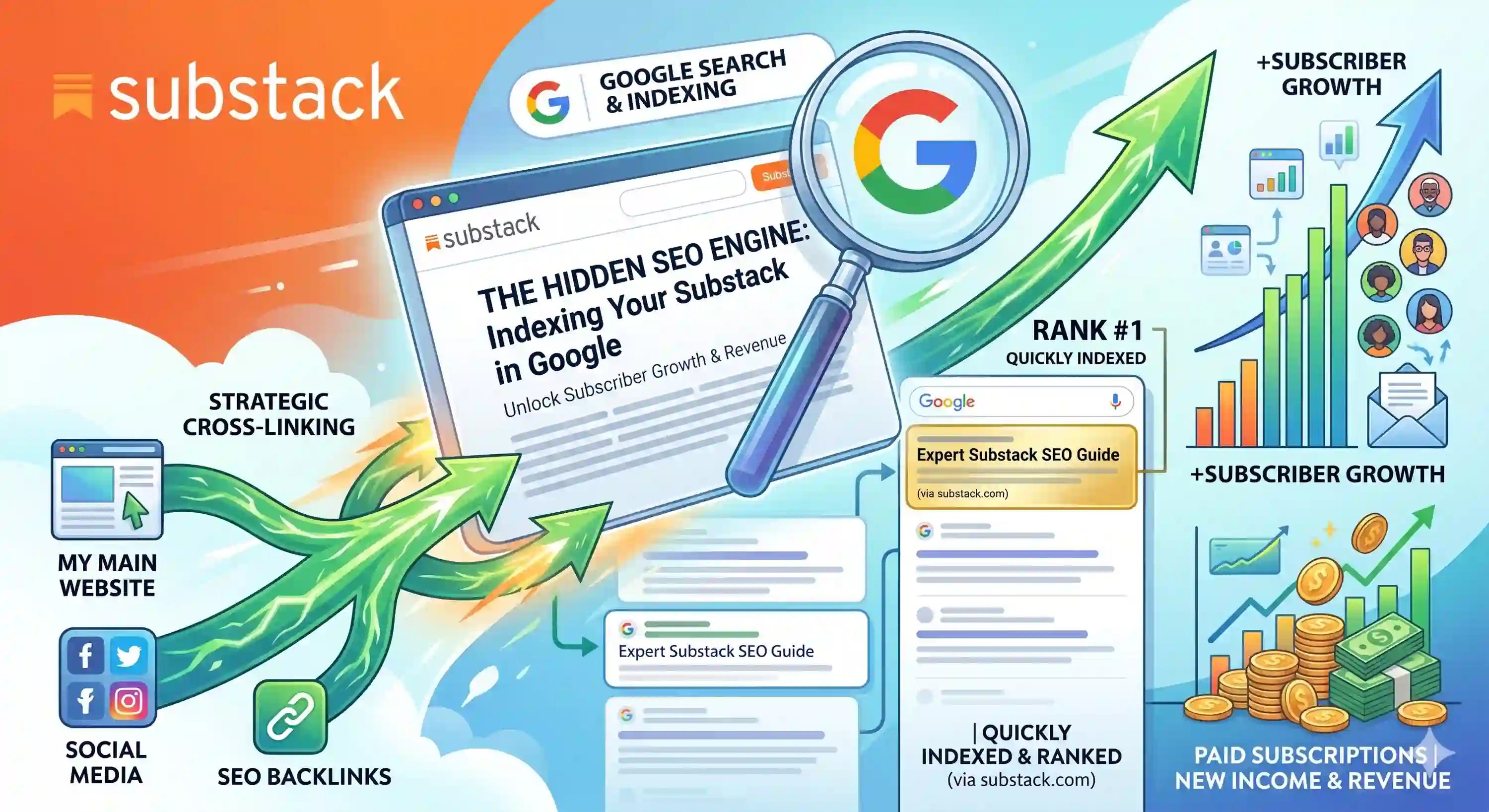
If you are publishing on Substack, you are participating in a massive digital ecosystem. As of early 2024, Substack boasted over 20 million active subscribers, becoming the de facto “home” for independent writers and cultural journalism. It has allowed creators to leave traditional newsrooms and build their own “mini media empires.”
But there is a glaring blind spot for many newsletter operators: Search Engine Optimization (SEO).
Writers often rely entirely on Substack’s internal network effects—the recommendation engine and the app—to grow their audience. While powerful, ignoring Google means leaving thousands of potential subscribers and thousands of dollars in recurring revenue on the table. Here is a deep dive into why indexing your Substack in Google is critical, how to rank quickly, and what it means for your bottom line.
Also read:
The 2026 Guide to Hiring & Partnering with Elite SEO Writers for High-Stakes Niches
The Importance of Google Indexing for Substack
To understand why indexing matters, you have to look at how the platform is built. Digital marketing infrastructure dictates who gets the “SEO juice.”
As noted by web developers and marketers, when your newsletter archive lives on Substack (e.g., yourname.substack.com), your readers go to Substack to read past issues. That is traffic that Substack gets, pages that Substack indexes, and domain authority that Substack keeps.
However, Substack has a major technical advantage that you can leverage: Server-Side Rendering (SSR).
According to recent research on web architecture, Google’s rendering service strongly favors server-rendered content over JavaScript-heavy sites. SSR implementations receive complete indexing at rates up to 3.4 times higher than standard client-rendered sites, with content often fully indexed within 48 hours instead of a week. Because Substack delivers clean, server-rendered HTML, your articles are primed to be read and indexed rapidly by Google’s crawlers. You just need to point them in the right direction.
Also read:
How to Index and Rank Your Articles Quickly
If you want your Substack to rank on page one, you cannot just hit “Publish” and pray. You need a deliberate linking strategy to force Google to notice, index, and elevate your content.
Strategic Cross-Linking from a High-Authority Domain: If you own a primary website or a personal blog with established domain authority, use it as a springboard. Publish an excerpt or a thematic summary on your main site, and link directly to the full Substack article. This passes your primary site’s “SEO juice” to your newsletter issue, prompting Google’s bots to crawl the Substack link immediately.
Utilize a Custom Domain: While Substack allows you to operate on their subdomain, investing in a custom domain for your Substack allows you to start building your own long-term search authority rather than continuously feeding Substack’s corporate domain.
Keyword-Optimized Titles and H2s: Search engine algorithms still rely heavily on titles. Ensure your Substack post title matches the search intent of your target audience. Use clear, descriptive headings inside the newsletter to structure the HTML so that Google understands exactly what the article solves.
The Financial Impact: Subscribers and Income
How much will this actually help? The transition from algorithmic discovery to search-intent discovery fundamentally changes your conversion rates.
When a user finds you via a Google search, they are exhibiting high-intent behavior. They actively searched for a solution or an analysis that your article provided. This user is statistically much more likely to enter their email to read more than someone passively scrolling a social media feed.
Once your indexed articles start ranking for evergreen keywords, your Substack transforms from a treadmill—where you only grow when you actively publish—into an asset. A well-ranked article acts as a 24/7 lead generation tool. If an indexed article brings in 1,000 organic visitors a month, and you convert just 5% of them to free subscribers (50 people), you are steadily building your funnel. If even 10% of those free subscribers eventually upgrade to a standard $5/month paid tier, a single well-ranked article can passively generate hundreds of dollars in annualized recurring revenue. Multiply that by dozens of indexed articles, and SEO becomes the financial backbone of your media empire.
Sources & Authors Quoted: This article references data on Substack’s 20M+ subscriber base and journalism impact from Acosta Meneses (MDPI, 2025), server-side rendering indexation speeds from Gaddam (Sarcouncil Journal, 2025), and SEO domain authority mechanics from digital marketing expert Gaurav Tiwari.